
Small Entryway Shoe Storage: 7 Options Compared — What’s Actually Worth It?
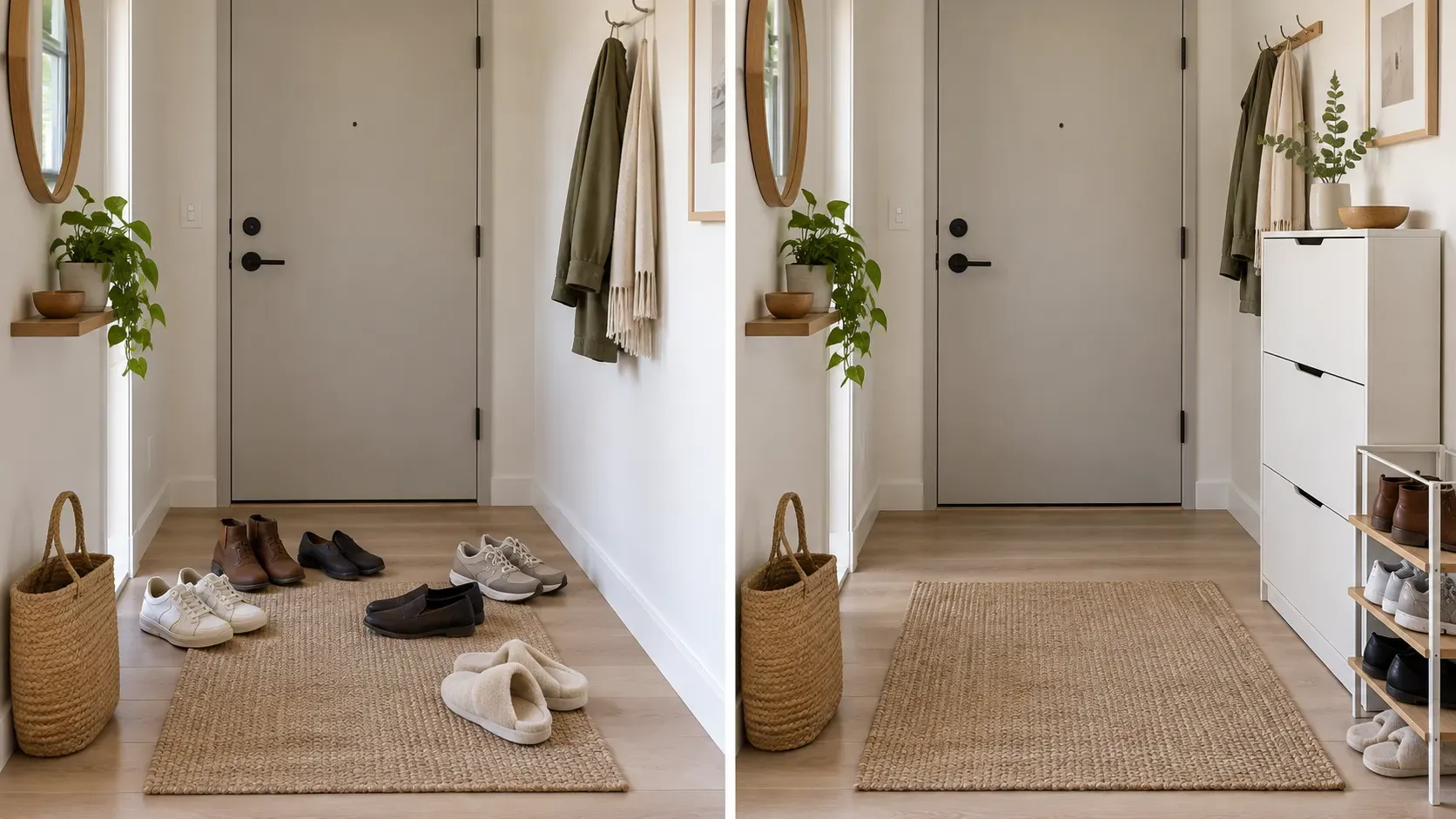
You clean the entryway.
A few hours later, the shoes are back.
Sneakers beside the door. Slippers halfway under the bench. Another pair kicked against the wall.
The problem isn’t always that you need more storage.
Sometimes you need storage that fits the way you actually use the space.
A large shoe rack may technically hold plenty of shoes, but if it sticks too far into a narrow hallway, it can make the room feel even smaller. A beautiful closed cabinet can hide clutter, but if opening it every time feels inconvenient, shoes may still end up on the floor.
So before buying another organizer, ask a different question:
What kind of shoe storage actually works for your entryway?
We compared seven common storage formats based on the things that matter most in a small space: footprint, accessibility, capacity, visual clutter, flexibility, and everyday usability.
The Short Answer
For many small entryways, the best solution comes down to what is bothering you most.
If visible clutter is the problem: start with a slim closed shoe cabinet.
If getting people to put their shoes away is the problem: an open rack is usually easier to live with.
If floor space is extremely limited: use vertical or over-the-door storage.
The most important rule?
Measure before you buy.
Before Buying a Shoe Organizer, Measure These 5 Things
1. Usable width
Don’t measure the entire wall.
Measure only the section that can actually hold storage without blocking a doorway, closet, outlet, vent, or other furniture.
A 36-inch wall doesn’t necessarily mean you have 36 usable inches.
2. Maximum depth
For a narrow entryway, depth may matter more than capacity.
Measure outward from the wall and decide how many inches of walkway you’re genuinely willing to sacrifice.
An organizer that looks compact online can feel surprisingly large once it’s sitting beside your front door.
3. Door swing
Open the front door completely.
Do the same with nearby closets.
Storage that technically fits against the wall may still interfere with how a door opens.
4. Your actual everyday shoe count
Don’t count every pair you own.
Count the pairs that routinely end up near the door.
If two people rotate among three pairs each, you probably don’t need a giant 30-pair organizer in the entryway.
5. Your largest footwear
Manufacturer capacity estimates don’t always reflect what you own.
Bulky sneakers, men’s shoes, high-tops, and boots require considerably more room than flats or slippers.
Measure before trusting the advertised pair count.
7 Small-Entryway Shoe Storage Options Compared
| Storage Type | Best For | Space Efficiency | Access | Hides Shoes? | Main Tradeoff |
|---|---|---|---|---|---|
| Slim shoe cabinet | Narrow visible entryways | Excellent | Good | Yes | Less flexible for bulky shoes |
| Open shoe rack | Everyday footwear | Good | Excellent | No | Shoes remain visible |
| Vertical shoe tower | Tiny floor footprint | Excellent | Excellent | No | Can look visually busy |
| Shoe-storage bench | Seating + storage | Fair | Good | Sometimes | Needs more floor space |
| Over-door organizer | Almost zero floor space | Excellent | Good | No | Not ideal for every shoe |
| Stackable/modular rack | Renters and changing needs | Good | Excellent | No | More utilitarian appearance |
| Drop-front boxes | Collections | Fair | Good | Partially | More space and effort per pair |
1. Slim Shoe Cabinet
Best for: Narrow entryways where visible clutter is the problem
A slim shoe cabinet solves something an ordinary rack doesn’t:
It makes the shoes disappear.
Instead of several rows of footwear being the first thing you see, a closed cabinet looks more like a piece of entryway furniture.
Tilt-out designs are particularly useful because they can store shoes without requiring the depth of a conventional horizontal shelf.
Example: Maupvit 3-Drawer Shoe Storage Cabinet
The Maupvit cabinet is a good example of the format we’re talking about. It uses three flip drawers and is approximately 9.45 inches deep, making it substantially shallower than many conventional storage pieces.
That makes it interesting for narrow hallways where every inch of walkway matters.
Why we like the concept:
- Closed design reduces visible clutter
- Shallow footprint compared with many conventional cabinets
- Three separate flip compartments
- Furniture-style appearance
- Useful when shoes are visible from the main living area
Things to consider:
Tilt-out compartments aren’t as forgiving as open shelves. Bulky sneakers, boots, and unusually large footwear may require more careful positioning.
And recently soaked shoes should be allowed to dry before being enclosed.
Worth the Upgrade verdict: Strong option when your main problem is seeing shoes everywhere rather than simply finding somewhere to put them.
Best for hiding clutter
Make the shoe pile disappear in under 10 inches: Maupvit 3-Drawer Shoe Storage Cabinet on Amazon
Maupvit 3-Drawer Shoe Storage Cabinet
(paid link)
2. Open Shoe Rack
Best for: Everyday convenience
An open rack isn’t particularly clever.
That may be exactly why it works.
Take your shoes off.
Put them on the shelf.
Done.
There are no drawers to open and no boxes to rearrange.
That lack of friction can matter more than appearance in a household where people regularly leave shoes on the floor.
Example: SONGMICS 2-Tier Stackable Shoe Rack
This SONGMICS model is a straightforward two-tier metal rack designed for compact spaces.
More importantly, it’s stackable, which gives you the option to expand later instead of buying a much larger organizer immediately.
Why this format works:
- Shoes are immediately accessible
- Different footwear shapes are easier to accommodate
- Simple storage behavior
- Can expand if your needs change
- Doesn’t require a large piece of furniture
The downside is equally obvious:
You can still see all the shoes.
If visual clutter is what’s bothering you, organizing those shoes into neat rows may not completely solve the problem.
Worth the Upgrade verdict: One of the most practical choices when easy everyday use matters more than hiding the shoes.
Best for everyday convenience
The no-effort rack your family will actually use: SONGMICS 2-Tier Stackable Shoe Rack on Amazon
SONGMICS 2-Tier Stackable Shoe Rack
(paid link)
3. Vertical Shoe Tower
Best for: Going up instead of out
A small entryway may not have much floor space.
But it often has unused height.
Vertical shoe storage takes advantage of that.
Instead of placing several pairs side by side, a narrow tower stacks them upward.
Example: HOOBRO 6-Tier Vertical Shoe Rack
The HOOBRO six-tier rack is approximately 11 × 11 inches at the base and 39.5 inches tall.
That small footprint is exactly what makes this style interesting.
You’re essentially trading horizontal space for vertical space.
Why it may work:
- Very small footprint
- Six vertical levels
- Useful beside doors or between furniture
- Easy access to individual pairs
- Doesn’t require a wide section of wall
The tradeoff is visibility.
A tall rack full of footwear can create more visual activity than a closed cabinet even if it uses very little floor space.
As with any tall, narrow furniture or shelving, follow the manufacturer’s assembly and stability instructions.
Worth the Upgrade verdict: Especially useful when width—not total storage capacity—is your biggest constraint.
Best for tight floor space
Six tiers of shoes on an 11-inch footprint: HOOBRO 6-Tier Vertical Shoe Rack on Amazon
HOOBRO 6-Tier Vertical Shoe Rack
(paid link)
4. Shoe-Storage Bench
Best for: When you need seating anyway
A storage bench solves two problems:
Where do the shoes go?
And where do you sit while putting them on?
This can make sense for families, children, older adults, or anyone who regularly sits while changing footwear.
But there’s an important catch.
A bench generally requires considerably more floor space than the other solutions in this guide.
If nobody needs a seat, you’re dedicating precious entryway space to a feature you aren’t actually using.
Worth the Upgrade verdict: Worth considering when a bench replaces both a chair and a shoe organizer. Less compelling if storage is the only problem you’re trying to solve.
5. Over-the-Door Shoe Organizer
Best for: When you have almost no available floor space
Sometimes the right amount of extra furniture for a tiny entryway is:
zero.
Over-the-door organizers use space that might otherwise do nothing.
They can work particularly well on a nearby closet door.
Example: GORILLA GRIP 24-Pocket Over-the-Door Organizer
The Gorilla Grip model uses 24 mesh pockets, allowing you to store footwear without giving up entryway floor area.
It’s especially suitable for lighter and smaller footwear.
Think:
- flats
- sandals
- slippers
- children’s shoes
- some low-profile sneakers
Before buying, check your door carefully.
Hooks can affect how some doors close, and bulky footwear may stick out substantially.
Worth the Upgrade verdict: Excellent space utilization when you have a suitable door and relatively compact footwear.
Best when you have no floor space
24 pockets of storage, zero floor space: GORILLA GRIP 24-Pocket Over-the-Door Organizer on Amazon
GORILLA GRIP 24-Pocket Over-the-Door Organizer
(paid link)
6. Stackable or Modular Shoe Storage
Best for: Renters and changing storage needs
You might need space for six pairs today.
You may need space for ten next year.
That’s where modular storage becomes useful.
Instead of buying one giant organizer, you can start small and expand when necessary.
The SONGMICS rack mentioned earlier is an example because multiple units can be stacked.
That gives it an advantage over fixed-size furniture for renters and households whose storage needs change.
Where modular storage falls short
Appearance.
Modular racks tend to emphasize functionality and flexibility over looking like permanent furniture.
That’s not necessarily a problem.
It just depends on whether the entryway is primarily functional or highly visible.
Worth the Upgrade verdict: A practical approach when flexibility matters more than a built-in look.
Best for renters
Start with one rack, stack another when you need it: SONGMICS 2-Tier Stackable Shoe Rack on Amazon
SONGMICS 2-Tier Stackable Shoe Rack
(paid link)
7. Drop-Front Shoe Boxes
Best for: Shoe collections rather than front-door clutter
Clear shoe boxes solve a different problem.
They’re less about creating somewhere to kick off your everyday shoes and more about keeping individual pairs organized, visible, and protected.
Example: Kuject X-Large Shoe Storage Boxes
The Kuject set includes 12 clear stackable shoe cases with front access.
The drop-front design matters because it means you don’t have to unstack multiple boxes simply to reach the pair at the bottom.
For a sneaker collection, that’s useful.
For an everyday entryway?
Maybe not.
Think about the routine:
Open box.
Put shoes inside.
Close box.
Now repeat for the second pair someone left beside the door.
Every additional step adds friction.
Worth the Upgrade verdict: Better suited to organized collections than everyday family shoe dumping.
Best for sneaker collections
Kuject X-Large Clear Shoe Storage Boxes (12-pack)
(paid link)
Shoe Cabinet vs. Shoe Rack: Which One Makes More Sense?
This will probably be the main decision for most people.
Choose a closed shoe cabinet if:
- You dislike seeing footwear
- Your entryway is visible from your main living area
- Usable depth is limited
- Your everyday shoes fit the compartments
- You’re willing to open and close storage every time
Choose an open rack if:
- Convenience matters most
- Several people share the entryway
- Shoes need somewhere quick to land
- You own footwear in many shapes and sizes
- You don’t mind seeing the shoes
Neither system is universally better.
A beautiful shoe cabinet that nobody uses is worse than a basic rack that actually keeps shoes off the floor.
Try the One-Motion Test
There’s one measurement you won’t find on a product listing.
We call it the One-Motion Test.
Ask:
After taking my shoes off, how much effort does it take to put them where they belong?
With an open rack:
Shoes off → shoes on rack.
With a cabinet:
Open → place shoes → close.
With individual boxes:
Open → place shoes → close → repeat.
Those additional actions sound insignificant.
But organization systems live or die through habits.
If leaving the shoes on the floor is considerably easier than putting them away, the system has a problem.
Don’t Buy Anything Until You Try This
Take every shoe currently sitting near the entrance and move it somewhere else.
Now return only the pairs your household actually uses during a normal week.
Look at what’s left.
You may discover that you don’t need storage for 25 pairs.
You need storage for eight.
That’s a much easier problem to solve.
An organizer doesn’t fix excess inventory.
Sometimes it simply gives us permission to keep more things in the same place.
What We Would Avoid
Oversized racks sold mainly on capacity
“Stores 30 pairs” doesn’t mean much if the rack overwhelms your hallway.
Deep furniture in narrow walkways
Every inch matters.
Storage chosen before measuring your shoes
Especially if you wear large sneakers or boots.
Complicated systems for everyday footwear
The organizer needs to be easier than the floor.
Buying based only on how it looks online
Measure first.
Then shop.
Which Shoe Storage Is Actually Worth It?
There isn’t one winner for every entryway.
There’s a better solution for each problem.
If you’re tired of looking at shoes:
Choose a slim closed cabinet such as the Maupvit 3-drawer cabinet (paid link).
If people simply won’t put their shoes away:
Choose a straightforward open rack such as the SONGMICS stackable rack (paid link).
If you barely have any floor space:
Consider the HOOBRO vertical rack (paid link) or an over-the-door organizer (paid link).
If you already need somewhere to sit:
Look for a shoe-storage bench.
If your needs change frequently:
Choose something stackable or modular.
If you’re organizing a shoe collection:
Individual drop-front boxes (paid link) make more sense than they do for everyday entryway shoes.
The Worth the Upgrade Checklist
Before buying any shoe organizer, ask:
- Have I measured the available width?
- Do I know my maximum acceptable depth?
- Have I checked the door swing?
- Have I counted only frequently used shoes?
- Have I measured my biggest everyday footwear?
- Do I want the shoes hidden or easily accessible?
- Will everyone in the household actually use this system?
- Have I checked the manufacturer’s installation and stability instructions?
If you can’t answer those questions yet:
Don’t buy anything. Measure first.
Frequently Asked Questions
What is the best type of shoe storage for a very small entryway?
If usable width is extremely limited, a vertical rack can make better use of height. If visual clutter is the bigger problem, a narrow tilt-out cabinet may make more sense. If floor space is effectively unavailable, consider an over-the-door organizer.
Is a shoe cabinet better than a shoe rack?
A cabinet is better at hiding clutter. An open rack is usually faster and easier to use. Which matters more depends on your household.
Are shoe cabinets good for large sneakers?
Not always. Tilt-out compartments can be more restrictive than open shelving, so check internal dimensions and compare them with your largest shoes before buying.
How many shoes should I keep near the front door?
Start with the pairs your household wears regularly. Seasonal, formal, and rarely used shoes usually don’t need valuable entryway space.
Should wet shoes go inside a closed shoe cabinet?
Let wet footwear dry before putting it into enclosed storage. If wet or muddy footwear is common, an open rack combined with an easy-to-clean tray may be more practical.
Are expensive shoe organizers worth buying?
Only when the additional cost solves a real problem—such as reducing depth, improving durability, hiding clutter, or combining two useful functions. If an inexpensive rack fits both your space and your habits, spending more isn’t automatically an upgrade.
Final Verdict
A shoe organizer is worth buying when it fixes a specific problem.
Not simply because it gives you another place to put things.
For a small entryway, start with three questions:
How much depth can I give up?
Do I want shoes hidden or immediately accessible?
Will everyone actually use this storage every day?
Answer those first.
Then buy the organizer.
That’s what makes it worth the upgrade.
How We Evaluated These Options
Worth the Upgrade has not claimed hands-on testing of the products mentioned in this guide. We selected them as examples of different shoe-storage formats and evaluated the practical tradeoffs of their designs, dimensions, accessibility, footprint, and intended use.
Product specifications can change. Check the current Amazon listing and manufacturer’s information before purchasing.