
Best Narrow Shoe Racks for Entryways: 6 Small-Space Picks
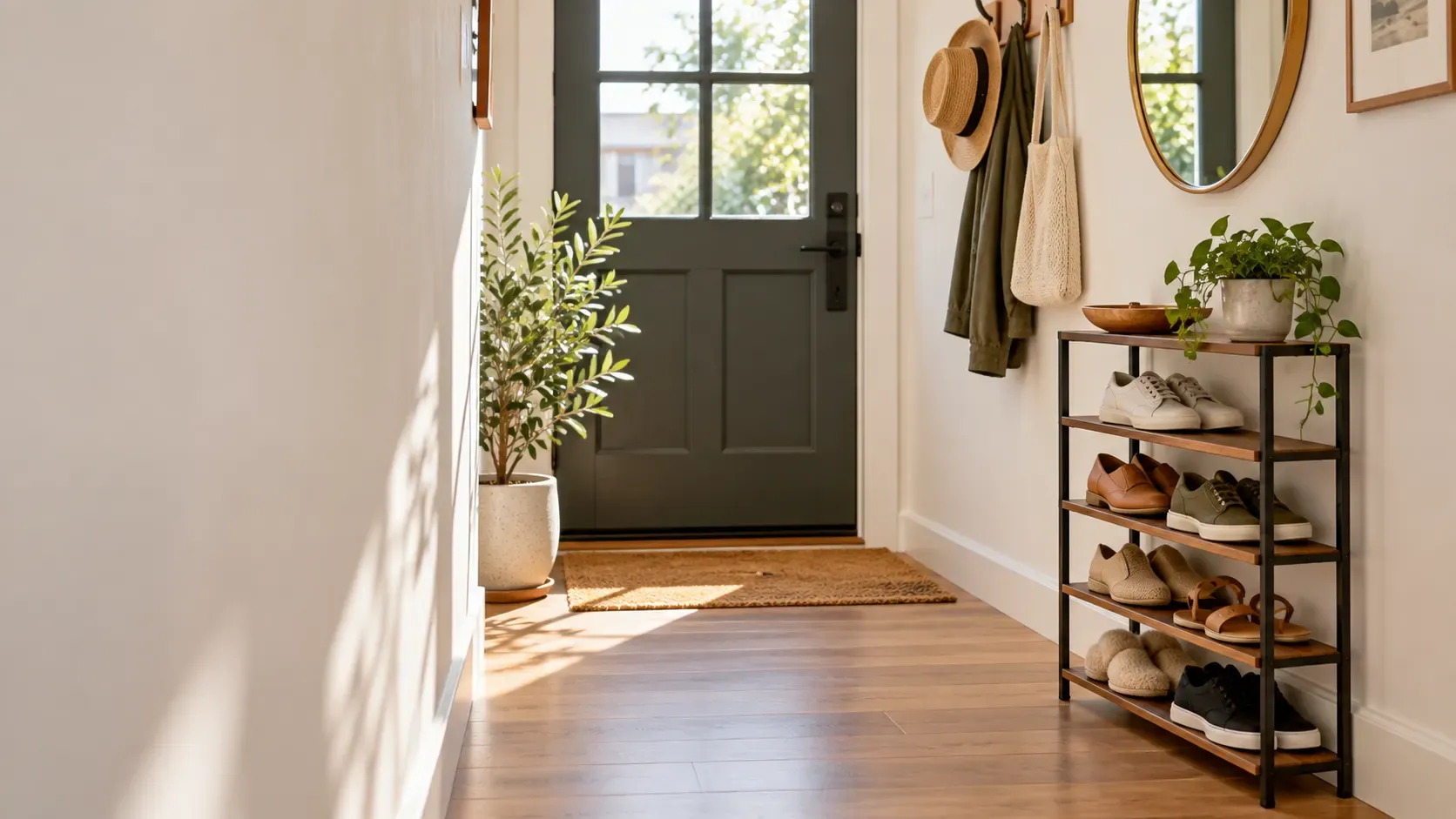
Shoes have a way of taking over a small entryway.
A few pairs by the front door may not seem like much, but in a narrow hallway or apartment entrance, they can quickly turn into something you have to step around every time you come home.
A shoe rack can fix the clutter—but only if the rack itself doesn’t become another obstacle.
For a narrow shoe rack for an entryway, capacity isn’t the only measurement that matters. Depth, available wall width, door swing, shoe size, and how much walking space remains after the rack is installed all matter just as much.
That’s why the picks below focus specifically on shoe storage that makes sense for small entryways, narrow hallways, foyers, and tight spaces near the front door.
Quick Picks: Narrow Shoe Racks for Small Entryways
Rather than choosing one rack as the universal “best,” start with the limitation your entryway actually has.
| Product | Best For | Width | Depth | Height | Approx. Capacity |
|---|---|---|---|---|---|
| VASAGLE 7-Tier Vertical Shoe Rack | Very limited wall width | 10.4” | 11.8” | 43.5” | 7 tiers |
| SONGMICS 8-Tier Narrow Shoe Rack | More shoes in a narrow footprint | 17.6” | 12” | 50.6” | Approx. 16–24 pairs |
| Yamazaki Line Expandable Shoe Rack | Very shallow, low-profile storage | 15”–27.25” | 5.91”* | 5.91” | Depends on width/shoe size |
| Yamazaki Frame Adjustable Shoe Rack | Expandable, stackable storage | 16.14”–27.25” | 9.84” | 6.89” | Approx. 4–6 pairs/unit |
| Simple Houseware 3-Tier Shoe Rack | Budget-friendly everyday storage | 26.8” | 11.2” | 20.9” | Approx. 9–16 pairs |
| VASAGLE HSC203 Shoe Cabinet | Hiding shoes from view | 32.7” | 9.4” | 40” | Approx. 14–16 pairs |
*The Yamazaki Line’s 5.91-inch measurement is the rack frame depth. Adult shoes can extend beyond the frame, so measure the loaded footprint rather than assuming your shoes will occupy only 5.91 inches.
How Narrow Should an Entryway Shoe Rack Be?
There isn’t one measurement that automatically makes a shoe rack “narrow.”
A 12-inch-deep rack might work perfectly in a roomy foyer but feel intrusive in a tight apartment hallway.
Instead, start with the space you need to preserve.
Measure these before buying
Measure your entryway width, then the amount of wall space available for the rack. Check the rack’s proposed location against your front door’s full swing, baseboards, trim, nearby furniture, coat hooks, and anything else that projects into the area.
Then pay particular attention to rack depth.
A useful starting calculation is:
Remaining walkway = total entryway width − shoe rack depth
For example, if your hallway is 42 inches wide and the rack extends 11 inches from the wall, your theoretical remaining walkway is 31 inches.
But treat that as a starting point—not a guarantee of usable clearance. Shoes may project beyond the rack, baseboards may prevent it from sitting flush against the wall, and an open door can occupy the same space.
Worth the Upgrade tip: Before ordering, place painter’s tape on the floor in the exact dimensions of the rack. Walk through the entryway several times and open the front door completely. It’s a much easier way to discover that a rack is too deep before assembling it.
The Best Narrow Shoe Racks for Entryways
1. VASAGLE 7-Tier Vertical Shoe Rack
Best for: Entryways with very little available wall width
A traditional three-tier rack can easily consume two or three feet of wall space. The VASAGLE 7-Tier takes the opposite approach: it goes up instead of out.
Its footprint is approximately 10.4 inches wide by 11.8 inches deep, while the rack stands about 43.5 inches tall.
That makes it particularly interesting for an awkward strip of wall beside a door where a wider rack simply won’t fit.
Why it works in a narrow entryway
The biggest advantage is the unusually small wall-width requirement. Seven tiers allow you to use vertical space that would otherwise go unused, while two side hooks provide a place for small accessories.
Published shelf spacing is approximately 6.7 inches, making it better suited to everyday sneakers, loafers, flats, and similar footwear than tall boots.
There is one important installation requirement: the manufacturer specifies using the supplied wall-attachment/anti-tip device. Don’t treat that as optional, particularly because of the rack’s tall, narrow proportions.
Consider it if: your biggest problem is lack of wall width.
Skip it if: you cannot secure it as directed, need substantial boot storage, or don’t have approximately 12 inches of usable depth.
Best for very little wall width
Seven tiers in a strip of wall just 10 inches wide: VASAGLE 7-Tier Vertical Shoe Rack on Amazon
VASAGLE 7-Tier Vertical Shoe Rack
(paid link)
2. SONGMICS 8-Tier Narrow Metal Shoe Rack
Best for: Storing more pairs without using a wide section of wall
If the VASAGLE prioritizes the narrowest possible width, the SONGMICS 8-Tier shifts the balance slightly toward capacity.
It measures about 12 inches deep, 17.6 inches wide, and 50.6 inches high. Published capacity is approximately 16 to 24 pairs, although the real number depends on shoe width, size, and how the shelves are configured.
Why it works in a narrow entryway
The roughly 18-inch width is still considerably easier to place than a broad horizontal organizer, while eight tiers make better use of vertical space.
It is particularly useful for households where the entryway needs to accommodate several people’s everyday shoes rather than two or three pairs.
The removable shelves are another advantage. If high-tops or taller footwear are part of your normal rotation, sacrificing one shelf can be more useful than forcing shoes into spaces that are too short.
Consider it if: you need relatively high capacity but have limited horizontal space.
Skip it if: your hallway is so shallow that a 12-inch projection already interferes with movement.
Best for more pairs
Up to 24 pairs on less than 18 inches of wall: SONGMICS 8-Tier Narrow Metal Shoe Rack on Amazon
SONGMICS 8-Tier Narrow Metal Shoe Rack
(paid link)
3. Yamazaki Line Expandable Shoe Rack
Best for: Low-profile storage where rack-frame depth matters most
The Yamazaki Line takes a completely different approach.
Rather than building upward, it’s a simple, low expandable frame measuring approximately 5.91 inches deep and 5.91 inches high, with a width that adjusts from about 15 inches to 27.25 inches.
Why it works in a small entryway
Its low height makes it easy to place underneath hooks, a floating shelf, mirror, window, or other wall feature.
The expandable width also gives you more control over the footprint than a fixed-width rack.
But here’s the measurement that matters:
5.91 inches is the frame depth—not necessarily the depth of the rack once shoes are on it.
An adult sneaker can extend substantially past the frame. If your concern is protecting every inch of walking space, measure one of your longest everyday shoes and mock up the loaded depth.
That’s more useful than relying on the rack specification alone.
Consider it if: you want minimalist, expandable storage and only keep a small active shoe rotation by the door.
Skip it if: you need high capacity or expect the published frame depth to equal the final loaded footprint.
Best low-profile rack
A 6-inch-high frame that tucks under hooks and mirrors: Yamazaki Line Expandable Shoe Rack on Amazon
Yamazaki Line Expandable Shoe Rack
(paid link)
4. Yamazaki Frame Adjustable Shoe Rack
Best for: Entryways where your required storage width may change
The Yamazaki Frame gives you a bit more structure than the Line model while retaining an adjustable footprint.
It measures approximately 9.84 inches deep, 16.14 inches wide, and 6.89 inches high in its compact configuration, with the width extending to around 27.25 inches.
Compatible units can also be stacked—up to two—using the supplied clips.
Why it works in a narrow entryway
Expandable racks make sense when your available wall width doesn’t match standard furniture dimensions.
Instead of buying a 30-inch rack and hoping it fits, you can adjust this one to the usable space.
The stacking option also gives you a way to increase capacity later without immediately committing to a tall shoe tower.
Consider it if: you value flexibility and prefer a low-profile open rack.
Skip it if: you need more than two stacked units or want completely concealed storage.
Best adjustable width
Widens from 16 to 27 inches, and stacks two high: Yamazaki Frame Adjustable Shoe Rack on Amazon
Yamazaki Frame Adjustable Shoe Rack
(paid link)
5. Simple Houseware 3-Tier Shoe Rack
Best for: A straightforward budget-friendly entryway setup
Not every small entryway requires a specialized vertical tower or premium expandable rack.
If you have about 27 inches of usable wall width, the Simple Houseware 3-Tier organizer offers a more conventional layout at approximately 26.8 inches wide, 11.2 inches deep, and 20.9 inches high.
The referenced model combines a metal frame with fabric/non-woven shelves, and its published capacity is roughly 9 to 16 pairs depending on shoe size and how the bottom space is used.
Why it works in a small entryway
The design is simple: three horizontal tiers, open access, and enough height to make better use of the floor area without turning into a tall tower.
It is particularly practical when width isn’t your biggest problem and you simply want everyday shoes off the floor.
The open design also makes frequently worn pairs easy to grab on the way out.
Consider it if: your entryway has enough wall width and you want uncomplicated storage.
Skip it if: your available wall section is very narrow. At nearly 27 inches wide, it’s considerably broader than the vertical options above.
Best budget pick
Simple Houseware 3-Tier Shoe Rack
(paid link)
6. VASAGLE HSC203 2-Flip-Drawer Shoe Cabinet
Best for: Hiding shoe clutter in a visible entryway
Sometimes the problem isn’t only how much room the shoes occupy.
It’s that you don’t want to see them.
The VASAGLE HSC203 is a closed shoe-storage alternative measuring approximately 32.7 inches wide, 9.4 inches deep, and 40 inches high. It uses two flip drawers rather than conventional outward-swinging cabinet doors.
Published capacity is roughly 14 to 16 pairs, depending on the footwear and divider configuration.
Why it works in a narrow entryway
The notable measurement here is the 9.4-inch closed depth.
That’s relatively shallow for a piece of enclosed furniture, while the flip-drawer format eliminates the large swing radius associated with a traditional cabinet door.
You still need clearance to open the drawers and stand in front of the cabinet, so don’t measure only its closed footprint.
The cabinet also includes anti-tip hardware, and the manufacturer specifies securing the unit appropriately.
Consider it if: your entryway is highly visible and you want shoes concealed.
Skip it if: wall width is your limiting factor. At 32.7 inches wide, this is the broadest option in our shortlist.
Best for hiding shoes
VASAGLE HSC203 2-Flip-Drawer Shoe Cabinet
(paid link)
Open Shoe Rack vs. Slim Shoe Cabinet
For small entryway shoe storage, the decision often comes down to easy access versus a cleaner appearance.
| Type | Main Advantage | Main Drawback | Best For |
|---|---|---|---|
| Open rack | Quick access and airflow | Shoes remain visible | Everyday footwear |
| Vertical rack | Stores more using less wall width | Height can affect stability | Very narrow wall sections |
| Flip-drawer cabinet | Hides shoes with relatively shallow depth | Needs opening clearance | Visible foyers and entryways |
| Expandable rack | Adjustable to available space | Usually lower capacity | Awkward wall widths |
| Bench rack | Can add seating | Typically wider/deeper | Entryways with more room |
If your shoes are frequently wet after rain, an open rack also provides more airflow. If visual clutter bothers you more than immediate access, a closed cabinet may be worth sacrificing some flexibility.
How Many Shoes Should You Keep in Your Entryway?
A small entryway doesn’t need to store your entire shoe collection.
In fact, trying to make it do that is often what causes the storage problem in the first place.
Think of the entryway as active shoe storage: the pairs you actually reach for during the week.
Keep frequently worn sneakers, work shoes, school shoes, flats, slippers, or walking shoes near the door. Move special-occasion shoes, seasonal footwear, and rarely worn pairs somewhere else.
If your entryway only has room for everyday shoes, move less-used pairs to the bedroom closet. Our guide to shoe racks for closet floors covers options designed to fit underneath hanging clothes and inside smaller closets.
What If Your Entryway Is Too Small for a Shoe Rack?
Sometimes even a narrow rack is still too much furniture.
If your front door opens directly into a tight hallway, consider whether the floor needs to remain completely unobstructed.
Behind-the-door organizers can move storage off the floor. Wall-mounted systems can use vertical space without creating a full furniture footprint. A very shallow flip-drawer cabinet may work where a conventional rack doesn’t, provided the opening motion still clears the walkway.
And if none of those options fit comfortably, the better solution may simply be keeping fewer pairs at the door and moving the rest into a closet.
A shoe organizer isn’t an upgrade if you’re squeezing around it every day.
Think About the Shoes, Not Just the Pair Count
A manufacturer’s capacity claim should be treated as an estimate.
Twelve pairs of women’s flats occupy very different space from twelve pairs of wide men’s sneakers.
Before choosing a rack, think about what will actually live on it.
Sneakers usually need more width and depth than flats or slippers.
High-tops need more shelf clearance.
Boots may require removing a shelf entirely or using the top level.
Heels can work poorly with certain open-bar or widely spaced rack designs.
Children’s shoes may allow you to fit considerably more pairs than the advertised adult-shoe estimate suggests.
That’s why the highest advertised pair count isn’t automatically the most useful specification. Your own shoe rotation is a better measurement.
Choose a Shoe Rack Based on Your Entryway
If you’re still deciding, start with the physical constraint you can’t change:
| Your Entryway Problem | Start With |
|---|---|
| Almost no wall width | VASAGLE 7-Tier Vertical |
| Need many pairs in limited width | SONGMICS 8-Tier |
| Need a very low rack | Yamazaki Line |
| Need adjustable width | Yamazaki Frame |
| Want inexpensive conventional storage | Simple Houseware 3-Tier |
| Want shoes hidden | VASAGLE HSC203 Cabinet |
| Door or walkway is still obstructed | Skip floor storage or reduce the number of entryway shoes |
The key is not finding the rack with the biggest capacity.
It’s finding the rack that solves your shoe clutter without creating a new space problem.
Frequently Asked Questions
What is the best shoe rack for a narrow entryway?
It depends on which dimension is limited. If you have very little wall width, a vertical rack such as the 10.4-inch-wide VASAGLE 7-Tier makes more sense. If depth is the bigger concern, start with a shallow rack or slim flip-drawer cabinet and measure the loaded footprint carefully.
How deep should an entryway shoe rack be?
There is no universal ideal depth because entryway widths differ. Instead, measure the full hallway or foyer width and subtract the loaded depth of the rack. Remember that shoes can protrude beyond an open rack’s published frame dimensions.
How do I store shoes in a very small entryway?
Limit storage near the door to frequently worn pairs first. Then consider vertical racks, expandable low-profile racks, shallow flip-drawer cabinets, wall-mounted storage, or behind-the-door organizers. Move seasonal and occasional shoes into another storage area.
Are vertical shoe racks stable?
A tall, narrow rack can be more sensitive to tipping than a broad, low rack. Follow the manufacturer’s installation instructions and use wall-attachment or anti-tip hardware whenever specified. The VASAGLE 7-Tier in this guide, for example, requires the supplied wall-attachment device.
Is an open shoe rack or closed cabinet better for an entryway?
Choose an open rack if quick access and airflow matter most. Choose a closed cabinet if the entryway is highly visible and hiding shoe clutter is more important. For very narrow spaces, compare not only cabinet depth but also the clearance required to open its drawers.
Where should a shoe rack go near the front door?
Place it where it doesn’t interfere with the door swing, normal walking path, or another door or closet. Before ordering, mock up the rack’s dimensions on the floor and open every nearby door fully.
How many pairs of shoes should I keep by the door?
There isn’t a fixed number. A better rule is to keep only your household’s active rotation near the entrance. If a pair hasn’t been worn recently, storing it elsewhere frees entryway space for shoes you actually use.
Final Thoughts
The best narrow shoe rack isn’t necessarily the smallest rack—or the one that holds the most shoes.
It is the one whose width, loaded depth, height, capacity, and access requirements match your particular entryway.
If wall width is scarce, go vertical. If the walking path is the problem, prioritize depth. If visible clutter bothers you, consider a shallow flip-drawer cabinet. And if your entryway still feels crowded after adding storage, reduce the number of shoes stored there rather than adding a larger organizer.
Measure first.
Then buy the storage that fits the space you actually have—not the entryway shown in the product photo.